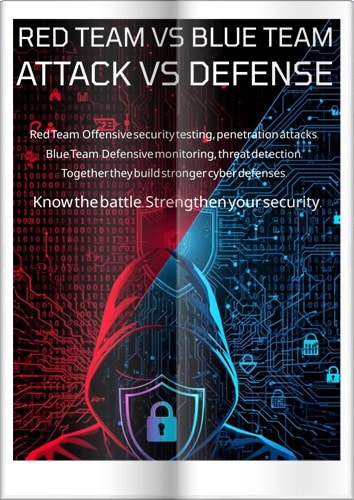
In cybersecurity, defending systems is not enough you also need to think like an attacker.
This is where the concept of Red Team vs Blue Team comes into play.
Organizations use these two teams to simulate real-world cyberattacks and defenses. One team attacks, the other defends. Together, they create a powerful system for identifying weaknesses and improving security.
Instead of reacting to threats after they occur, this approach helps organizations proactively strengthen their defenses.
In this guide, you’ll learn what Red Team and Blue Team are, how they differ, and why they are essential in modern cybersecurity.
What Is a Red Team?
The Red Team represents attackers in a controlled and ethical manner. Their goal is to simulate real-world cyberattacks to test an organization’s security.
Red Team members use techniques similar to malicious hackers, including reconnaissance, exploitation, and social engineering.
Unlike traditional penetration testing, Red Team operations are more comprehensive and stealthy. They aim to mimic advanced persistent threats (APTs) and test not just systems, but also people and processes.
The objective is not just to find vulnerabilities, but to see how far an attacker can go without being detected.
This makes Red Teaming one of the most realistic ways to evaluate security.
Key Responsibilities of a Red Team
Red Teams focus on offensive security activities designed to expose weaknesses.
- Simulating real-world cyberattacks
- Identifying vulnerabilities in systems and networks
- Testing employee awareness through social engineering
- Bypassing security controls
- Evaluating detection and response capabilities
Their work helps organizations understand how attackers think and operate.
What Is a Blue Team?
The Blue Team is responsible for defending systems against attacks.
They focus on monitoring, detecting, and responding to security threats in real time.
While the Red Team simulates attacks, the Blue Team works to stop them.
Blue Team members use tools such as intrusion detection systems, SIEM platforms, and endpoint protection solutions to identify suspicious activity.
Their goal is to minimize damage and respond quickly to incidents.
This defensive approach is essential for maintaining a secure environment.
Key Responsibilities of a Blue Team
Blue Teams focus on defensive security operations.
- Monitoring systems for suspicious activity
- Detecting and responding to threats
- Managing security tools and controls
- Conducting incident response
- Improving security policies and procedures
They play a critical role in protecting organizations from cyberattacks.
Red Team vs Blue Team: Core Differences
Although both teams work toward the same goal — improving security — their approaches are very different.
1. Offensive vs Defensive Approach
The Red Team focuses on offense, attempting to exploit vulnerabilities.
The Blue Team focuses on defense, working to detect and stop attacks.
This contrast creates a balanced security strategy.
2. Objectives
Red Teams aim to identify weaknesses by simulating attacks.
Blue Teams aim to protect systems and respond to threats.
Together, they provide a complete view of security.
3. Tools and Techniques
Red Teams use hacking tools and techniques to simulate attacks.
Blue Teams use monitoring and defense tools to detect and respond.
Both rely on advanced technologies but use them differently.
4. Mindset
Red Teams think like attackers.
Blue Teams think like defenders.
This difference in mindset is what makes the approach effective.
Why Red Team vs Blue Team Is Important
Modern cyber threats are complex and constantly evolving.
Traditional security measures are not enough to defend against advanced attacks.
The Red Team vs Blue Team approach provides a more dynamic and realistic way to improve security.
1. Identifies Hidden Vulnerabilities
Red Team exercises uncover vulnerabilities that may not be detected through standard testing.
This helps organizations address weaknesses before attackers exploit them.
2. Improves Detection Capabilities
Blue Teams learn to detect attacks more effectively through real-world simulations.
This improves their ability to respond to actual threats.
3. Strengthens Incident Response
Simulated attacks provide valuable experience for Blue Teams.
They learn how to respond quickly and efficiently under pressure.
4. Enhances Overall Security Strategy
By combining offensive and defensive approaches, organizations can build a more comprehensive security strategy.
This leads to stronger protection against cyber threats.
How Red and Blue Teams Work Together
Although Red and Blue Teams have different roles, they are not adversaries in the traditional sense.
They work together to improve security.
After a Red Team exercise, findings are shared with the Blue Team.
This helps the Blue Team understand weaknesses and improve defenses.
This collaborative approach ensures continuous improvement.
Learn more about monitoring and detection in our network monitoring guide
What Is a Purple Team in Cybersecurity?
While Red Teams and Blue Teams are essential, many organizations have realized that true security improvement happens when both teams collaborate effectively. This is where the concept of a Purple Team comes in.
A Purple Team is not a separate group but a collaborative approach that integrates the efforts of Red and Blue Teams. Instead of working in isolation, both teams share knowledge, insights, and strategies in real time.
The goal is to maximize the effectiveness of security testing and defense by ensuring that lessons learned from attacks are immediately applied to improve defenses.
For example, when a Red Team discovers a vulnerability, the Blue Team can quickly analyze how it was exploited and update detection mechanisms.
This continuous feedback loop accelerates learning and strengthens overall security.
Purple Teaming is considered a best practice in modern cybersecurity because it combines offensive and defensive strategies into a unified approach.
Tools Used by Red Teams
Red Teams rely on a variety of tools to simulate real-world attacks. These tools help them identify vulnerabilities, exploit weaknesses, and move within systems without detection.
1. Reconnaissance Tools
Reconnaissance tools help gather information about targets.
They identify domains, subdomains, and exposed services.
This information is critical for planning attacks.
2. Exploitation Frameworks
These tools allow Red Teams to exploit vulnerabilities.
They simulate real-world attacks and help validate weaknesses.
They are essential for testing how far an attacker can go.
3. Social Engineering Tools
Red Teams often test human vulnerabilities.
These tools simulate phishing attacks and other social engineering techniques.
This helps evaluate employee awareness and response.
4. Post-Exploitation Tools
After gaining access, Red Teams use these tools to maintain control and move within systems.
This helps simulate advanced attacks and assess impact.
Tools Used by Blue Teams
Blue Teams use defensive tools to monitor systems, detect threats, and respond to incidents.
1. SIEM Platforms
Security Information and Event Management (SIEM) systems collect and analyze data from multiple sources.
They help identify suspicious activity and provide centralized visibility.
2. Intrusion Detection and Prevention Systems
These systems monitor network traffic for malicious activity.
They can detect and sometimes block attacks in real time.
3. Endpoint Security Tools
These tools protect individual devices such as computers and servers.
They detect malware, unauthorized access, and other threats.
4. Threat Intelligence Platforms
These platforms provide information about emerging threats.
They help Blue Teams stay updated and improve detection capabilities.
Real-World Red Team vs Blue Team Scenario
Understanding theory is important, but real-world scenarios provide deeper insights into how Red and Blue Teams operate.
Consider a company that wants to test its security posture.
The Red Team begins by gathering information about the organization, identifying potential entry points such as exposed servers or vulnerable applications.
They then attempt to exploit these weaknesses to gain access.
Meanwhile, the Blue Team monitors systems for unusual activity.
If the Red Team’s actions trigger alerts, the Blue Team investigates and responds.
This may involve isolating affected systems, blocking malicious traffic, or analyzing logs.
After the exercise, both teams review the results.
The Red Team explains how they exploited vulnerabilities, while the Blue Team evaluates its response.
This process helps identify gaps and improve security.
Red Team vs Blue Team vs Purple Team
To fully understand modern cybersecurity strategies, it is important to compare all three approaches.
- Red Team: Focuses on attacking systems to identify vulnerabilities
- Blue Team: Focuses on defending systems and responding to threats
- Purple Team: Combines both approaches for continuous improvement
Each plays a unique role, but together they create a comprehensive security strategy.
Organizations that adopt all three approaches are better equipped to handle complex threats.
When Should Organizations Use Red Teaming?
Red Teaming is not always necessary for every organization, but it becomes essential in certain situations.
1. Testing Advanced Security Controls
Organizations with mature security systems use Red Teaming to test their effectiveness.
This helps identify weaknesses that standard testing may miss.
2. Evaluating Incident Response
Red Team exercises help evaluate how well teams respond to real-world attacks.
This improves preparedness and response capabilities.
3. Protecting Critical Assets
Organizations handling sensitive data or critical infrastructure benefit from Red Teaming.
It helps ensure that their defenses are strong enough.
4. Compliance and Security Audits
Some regulations require advanced security testing.
Red Teaming helps meet these requirements.
How This Connects to Modern Security Operations
Red Team vs Blue Team is closely linked to modern security operations such as SOC (Security Operations Center) and continuous monitoring.
Blue Teams often operate within SOC environments, where they monitor and respond to threats in real time.
Red Team exercises help test the effectiveness of these operations.
Learn more in our SOC security guide
This integration ensures that organizations can detect, respond, and recover from attacks effectively.
Advanced Best Practices for Red and Blue Teams
To fully benefit from Red Team and Blue Team operations, organizations must go beyond basic implementation and adopt advanced best practices. These practices ensure that both offensive and defensive efforts deliver meaningful results.
1. Continuous Testing Instead of One-Time Exercises
Cyber threats evolve constantly, making one-time testing insufficient.
Organizations should conduct regular Red Team exercises to identify new vulnerabilities and validate existing defenses.
Continuous testing ensures that security remains effective in dynamic environments.
2. Realistic Attack Simulations
Red Team exercises should mimic real-world attack scenarios as closely as possible.
This includes using advanced techniques such as social engineering, lateral movement, and stealth tactics.
Realistic simulations provide more accurate insights into security weaknesses.
3. Strong Communication Between Teams
Effective communication is critical for success.
Red and Blue Teams should share findings, insights, and lessons learned.
This collaboration helps improve detection and response capabilities.
4. Focus on Detection and Response
Finding vulnerabilities is important, but detecting and responding to attacks is equally critical.
Blue Teams should focus on improving visibility, monitoring, and incident response.
This ensures that threats are identified and handled quickly.
5. Measure Performance with Metrics
Organizations should track key metrics such as detection time, response time, and number of vulnerabilities identified.
These metrics help evaluate the effectiveness of security operations.
Continuous measurement enables ongoing improvement.
Career Paths: Red Team vs Blue Team
One of the biggest advantages of learning about Red and Blue Teams is the wide range of career opportunities they offer.
Each path requires different skills and interests, allowing individuals to choose what suits them best.
Red Team Careers
Red Team roles focus on offensive security.
Common job titles include penetration tester, ethical hacker, and security consultant.
These roles require strong technical skills, creativity, and the ability to think like an attacker.
Professionals in this field often work on simulating attacks and identifying vulnerabilities.
Blue Team Careers
Blue Team roles focus on defense and protection.
Common job titles include security analyst, incident responder, and SOC analyst.
These roles require skills in monitoring, threat detection, and incident response.
Blue Team professionals play a critical role in maintaining security.
Which Path Should You Choose?
The choice depends on your interests.
If you enjoy breaking systems and finding weaknesses, Red Team roles may be a better fit.
If you prefer defending systems and responding to threats, Blue Team roles may be more suitable.
Some professionals develop skills in both areas, making them highly valuable in the industry.
Future of Red Team vs Blue Team
The future of cybersecurity will continue to rely heavily on Red and Blue Teams.
As cyber threats become more advanced, organizations will need stronger and more adaptive security strategies.
Artificial intelligence and machine learning are expected to play a major role in both offensive and defensive operations.
Red Teams may use AI to simulate more sophisticated attacks, while Blue Teams may use it to improve threat detection and response.
Cloud computing and remote work environments are also changing how security is managed.
This will require new approaches to testing and defense.
The integration of Red, Blue, and Purple Teaming will become more common, creating a unified approach to cybersecurity.
How Red Team vs Blue Team Strengthens Overall Cybersecurity
The combination of Red and Blue Teams creates a balanced and effective security strategy.
Red Teams identify vulnerabilities, while Blue Teams work to defend against them.
This continuous cycle of testing and improvement helps organizations stay ahead of threats.
It also builds a culture of security awareness and proactive defense.
When combined with practices such as penetration testing
organizations can achieve a higher level of security maturity.
This layered approach is essential for protecting modern digital environments.
Conclusion
Red Team vs Blue Team is more than just a comparison — it is a powerful cybersecurity strategy.
By combining offensive and defensive approaches, organizations can identify weaknesses, improve detection, and strengthen their defenses.
This approach provides a realistic and dynamic way to address modern cyber threats.
As technology continues to evolve, the importance of Red and Blue Teams will only increase.
For individuals, this field offers exciting career opportunities and the chance to make a real impact in cybersecurity.
Frequently Asked Questions
What is Red Team vs Blue Team?
It is a cybersecurity approach where one team simulates attacks and the other defends.
What is a Purple Team?
It is a collaborative approach combining Red and Blue Teams.
Which is better, Red Team or Blue Team?
Both are important and serve different purposes.
Is Red Teaming the same as penetration testing?
No, Red Teaming is broader and more comprehensive.
Can beginners start a career in this field?
Yes, with proper learning and practice.
Call to Action
Start building your Red Team or Blue Team skills today and take your cybersecurity knowledge to the next level.